Decision guides · Swiss hotel management
Why choose IMI Switzerland? Curriculum, internships and value matter more to me than luxury facilities
| **By James Liu | Lux Education Partners | Reviewed 25 September 2026** |
I see IMI as a school worth considering for its curriculum, practical experience and value. Its facilities are not the most luxurious I have visited, but that is only one part of an education decision.
As an entrepreneur based in Europe, I ask what a student will learn, what experience they can gain and how the family’s investment connects with their future.
IMI is in the Lucerne area and teaches in English. Its bachelor’s choices connect to different interests:
| Route | Subjects | Directions to prepare for |
|---|---|---|
| Hospitality business | Operations, accounting, revenue, people, marketing and events | Hotel operations, events, customer experience and revenue roles |
| International business | Business foundations, trade, finance, law, strategy and intercultural management | Service businesses, international business and marketing |
| Culinary management | Culinary practice, baking, safety, kitchens, menus and entrepreneurship | Professional kitchens, food businesses and product development |
A future restaurant owner needs purchasing, costing and team management as well as cooking. Someone more interested in how a hotel earns money may find the hospitality business route more relevant. We begin with the student’s interests.
A degree that alternates study with work
IMI offers bachelor’s routes in international hospitality business management, international business management and international culinary management. Each combines three 22-week study periods with two compulsory 22-week paid internships; a third internship is optional.
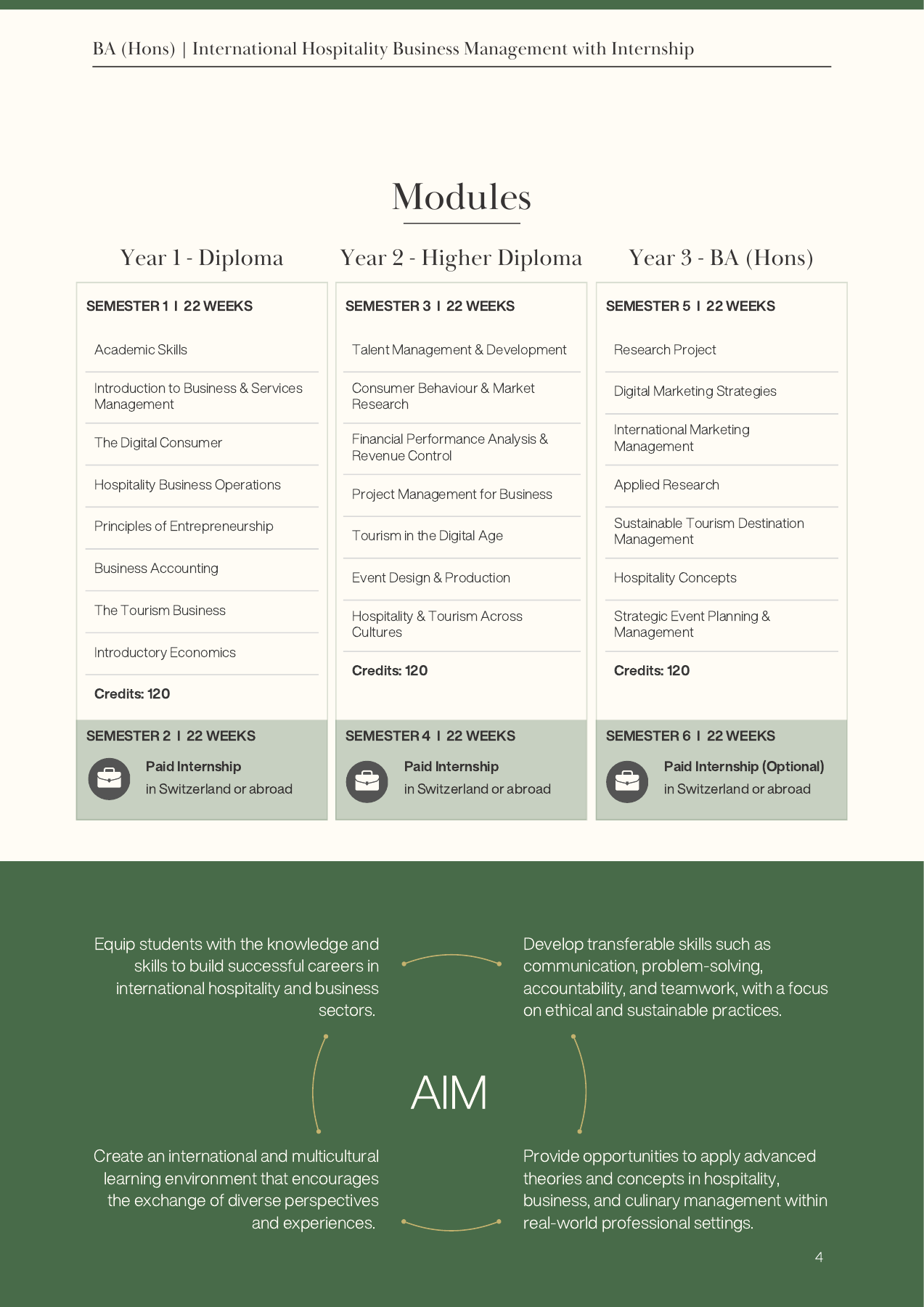
A first placement may reveal a language gap, an area the student enjoys or a work habit to improve. Returning to class with that experience makes later teaching more concrete. The second placement can then serve a clearer purpose.
What does value look like in actual figures?
IMI’s 2026 partner presentation uses the following hospitality or business bachelor’s example for one charging year:
| Item | CHF |
|---|---|
| Tuition | 33,000 |
| Registration | 2,000 |
| One campus accommodation and meal period in the example | 5,950 |
| Illustrative partner benefit | −6,000 |
| Total of these items | 34,950 |
This is a school illustration, not the full three-year cost or an individual offer. LEP works with the school to establish the benefits and scholarships applicable to the student’s programme and intake.
The presentation then uses six months at CHF 2,390 gross per month: CHF 14,340. Subtracting that gives CHF 20,610, before internship living costs and payroll deductions are accounted for. Our family budget includes those costs and the dates on which money is needed.
Paid work can reduce part of the expense while building experience. The useful comparison therefore includes tuition, approved benefits, living costs and realistic placement earnings.
Modest facilities do not mean an easy academic route
The campus is not a luxury proposition: that is my impression from visiting. Accounting, economics, revenue analysis and research still require serious study. The master’s includes assets, strategy, research methods and a dissertation.
I discuss facilities and teaching separately. A student should feel comfortable where they live, while also understanding what they will be expected to learn and complete.
What comes after a bachelor’s?
Graduates can pursue employment or apply for further study at IMI or another university. IMI’s MSc International Hospitality Business Management lists 22 weeks of teaching, 22 weeks of dissertation work and optional professional practice. Its current requirements accept bachelor’s graduates from any discipline, subject to the programme’s conditions.
For another university’s master’s, we work backwards from that programme’s qualification, grade, language and prerequisite requirements. A student can prepare during the bachelor’s rather than wait until graduation.
IMI also offers Graduate Diplomas in International Hospitality Management and International Culinary Arts. These are professional diplomas, not MSc degrees. They can suit a different purpose, such as concentrated sector training or a career change.
School materials record alumni experiences in healthcare environmental services, digital products, restaurant entrepreneurship and events, as well as hospitality. They illustrate possibilities; a career plan still needs relevant experience and employer connections.
Unsure about committing? Experience the school first
The published winter programme runs 17–24 January 2027, for ages 16–24. Students can experience classes, campus life and activities before deciding whether hospitality, business or culinary study suits them.
Successful participants who join an eligible longer-term IMI programme within two years can credit the camp fee actually paid against first-year tuition. Our separate camp guide explains the dates, costs and conditions.
What does applying through LEP add?
LEP is a formal IMI partner. We communicate directly with the school on programme choices, application requirements and applicable scholarships. Long-term contact helps us explain a student’s strengths and pursue support relevant to their application.
My work in Europe also brings ongoing relationships with local entrepreneurs, hotel groups and other business contacts. For suitable, prepared students, those relationships support introductions and employment recommendations. Admission is the beginning of that discussion.
Our Swiss hospitality partnerships also include Swiss Hotel Management School (SHMS), César Ritz Colleges Switzerland, HIM Business School (formerly Hotel Institute Montreux) and Culinary Arts Academy Switzerland, within SEG. We compare relevant partner options when another route better matches the student.
Tell us your present qualification, English level, budget and intended intake. We can connect programme selection with scholarships and the next stage of your education or career.
Explore IMI programmes, costs and applications
- Why study hospitality management in Switzerland? Start with what you want to do afterwards
- IMI bachelor’s, MSc or Graduate Diploma: which programme fits your next step?
- What does IMI Switzerland cost? Tuition, scholarships, living costs and internship income
- IMI internships and graduate careers: experience matters, and so does the person willing to recommend you
- Applying to IMI Switzerland? LEP can handle programme selection, scholarships and the application with you
- What I look for when visiting IMI: the student’s future beyond the campus
- IMI Winter Programme 2027: CHF 1,800 early fee and a possible credit towards later tuition
If you are facing this decision, let's talk. contact@luxedupartners.lu →