Decision guides · Swiss hotel management
IMI internships and graduate careers: experience matters, and so does the person willing to recommend you
| **By James Liu | Lux Education Partners | Reviewed 25 September 2026** |
One reason I take IMI seriously is the place of internships in its bachelor’s programmes. Graduates can leave with work experience and the beginnings of an employer network, rather than a qualification alone.
Planning should go further than “the school offers internships”. What should the first job teach? How should the second placement differ? Who will know the student’s work well enough to recommend them at graduation?
The undergraduate placement structure
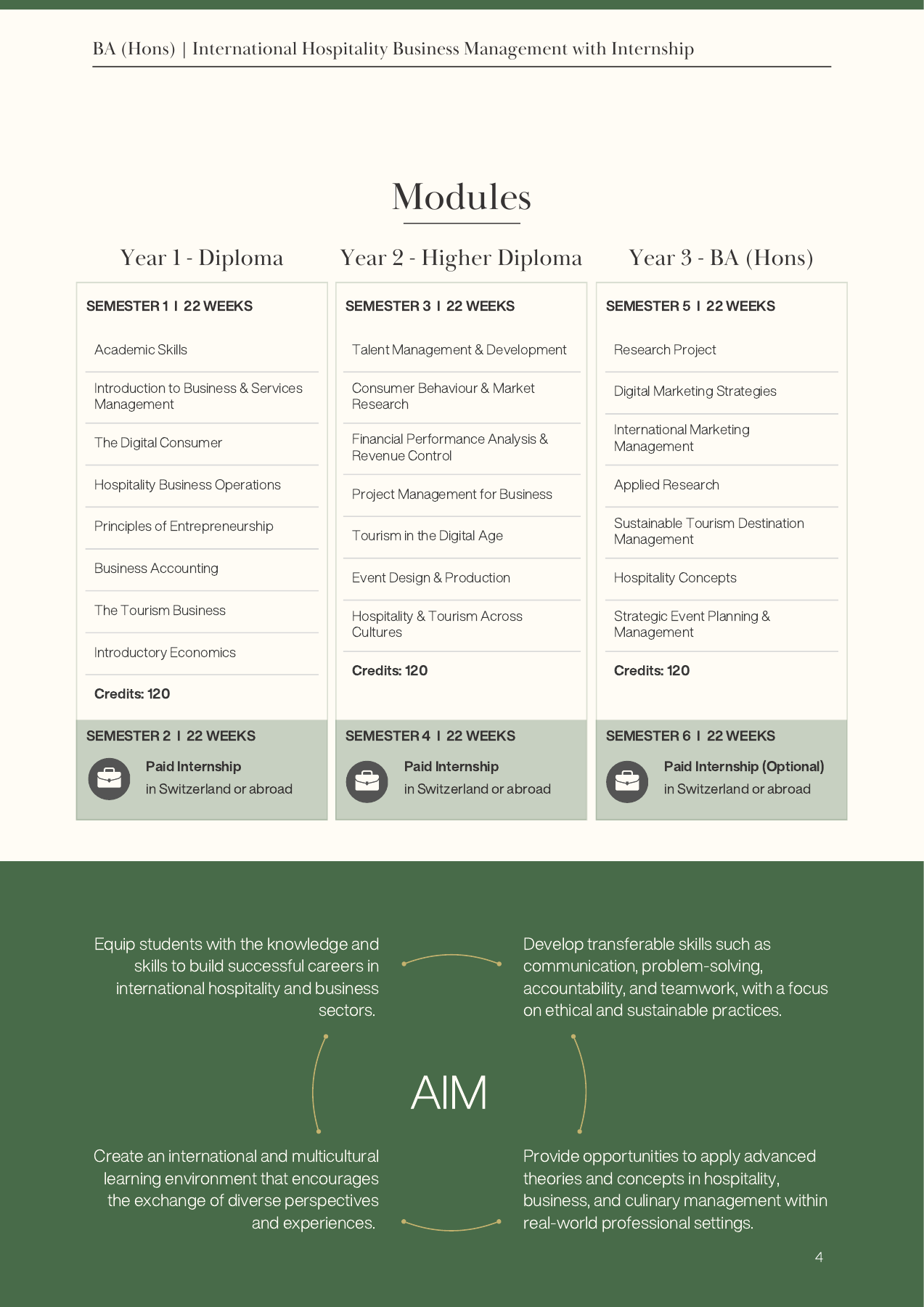
Alternating study and work creates opportunities to adjust. After the first placement, students understand more about their language skills and working habits. They can choose the next placement with a clearer purpose.
Postgraduate structures differ. The specific MSc brochure lists up to 44 weeks of optional professional practice; Graduate Diplomas list an optional 22-week internship. The bachelor’s timetable should not be applied to every programme.
What does the school’s careers team contribute?
IMI describes support with CV preparation, applications, interviews and employer connections. Students still participate in recruitment, attend interviews and meet workplace expectations.
That support is useful for a first professional experience. English communication, service awareness and reliability become visible in interviews and at work. I encourage students to prepare early enough to develop these abilities.
Three things I want a student to bring back from a first placement
| What to gain | What it means in practice |
|---|---|
| Evidence of work completed | Tasks handled, problems solved and contribution to the team |
| Feedback they can use | What a supervisor valued and what needs improvement |
| Professional relationships | Supervisors and colleagues who know how they work |
Operational work can be repetitive and demanding. Resolving a complaint, maintaining standards under pressure and becoming dependable give other people reasons to recommend a student.
My view is that real-world trust will become increasingly valuable. Before someone entrusts a client, project or job to you, they need to know how you work.
Career possibilities beyond hotels
IMI teaches operations, marketing, finance, people and project management. Its 2026 presentation records these alumni examples:
| Alumnus and study route | Experience recorded by IMI |
|---|---|
| Sarvesh Mehrotra, hospitality business bachelor’s | Environmental services management at Vancouver Coastal Health, Canada |
| Sean Dunne, international business bachelor’s | Global digital product management at Curaden, Switzerland |
| Pranav Yogesh, culinary management bachelor’s | Restaurant entrepreneurship at Nimaya, Zurich |
| Antoine Golinvaux, MSc | Event project coordination at MCI, Geneva |
These are experiences recorded in the school’s materials, not a claim that each person holds the same role today. They help identify possible directions. The next question is what a particular employer requires and how the student can build the relevant experience.
Further study at IMI or another university is another route. Strong grades, languages and projects can keep both work and postgraduate options open.
Why employment recommendations are central to LEP
I operate businesses in Europe and maintain relationships with local entrepreneurs, hotel groups, family offices and other business contacts. We open that established network to families who work with LEP.
In markets such as Luxembourg, Switzerland and the Netherlands, reputation and repeated cooperation matter. An employer listens to a recommendation because they know the person making it and trust their judgment. That relationship takes time to build locally.
A student contacting an unfamiliar company alone and a student introduced by a trusted business contact begin the conversation differently. This is part of the practical value we bring.
We also need to know the student: interests, language ability, placement performance and fit for the employer. Schools need good students; businesses need suitable staff; we need students whom both can value. We first select students and match countries and schools, help them develop, and then introduce suitable people to suitable employers.
Planning to work in Europe? Consider your actual work rights
For some students, finding a role is only part of the challenge; the ability to take that job is another. A Swiss study experience does not automatically confer permission to work in Switzerland or elsewhere in Europe.
An EU/EFTA citizen and a citizen of another country may face different conditions. Existing residence status also matters, and each target country has its own rules. Speaking English or French tells us nothing conclusive about a person’s work rights.
We discuss the intended market, languages, current status and possible transitions early. Broader family residence planning can connect with relevant SBMG services. My base is Luxembourg, with commercial and employer relationships in Switzerland, the Netherlands, Ireland and Austria; the discussion can therefore look beyond remaining in Switzerland alone.
Develop ability during study, earn recognition during placements, build relationships that support recommendations and prepare the necessary residence and work arrangements. That is the longer-term route I want LEP to help families build from the application stage.
Explore IMI programmes, costs and applications
- Why study hospitality management in Switzerland? Start with what you want to do afterwards
- Why choose IMI Switzerland? Curriculum, internships and value matter more to me than luxury facilities
- IMI bachelor’s, MSc or Graduate Diploma: which programme fits your next step?
- What does IMI Switzerland cost? Tuition, scholarships, living costs and internship income
- Applying to IMI Switzerland? LEP can handle programme selection, scholarships and the application with you
- What I look for when visiting IMI: the student’s future beyond the campus
- IMI Winter Programme 2027: CHF 1,800 early fee and a possible credit towards later tuition
If you are facing this decision, let's talk. contact@luxedupartners.lu →