Decision guides · Swiss hotel management
What does IMI Switzerland cost? Tuition, scholarships, living costs and internship income
| **By James Liu | Lux Education Partners | Reviewed 25 September 2026** |
I consider IMI worth examining for value: substantive teaching, opportunities to apply for partner benefits and scholarships, and paid internships that bring both income and experience. A useful family budget brings all of those together.
The published three-year tuition and registration total for the hospitality business or international business bachelor’s is CHF 105,000 before discounts, with accommodation and meals additional. LEP works with the school on benefits applicable to the chosen programme, intake and applicant.
Start with programme charges
| Programme | Published charges in CHF |
|---|---|
| Hospitality business bachelor’s: three years, tuition and registration | 105,000 |
| International business bachelor’s: three years, tuition and registration | 105,000 |
| Culinary management bachelor’s: three years, tuition, registration and equipment | 118,500 |
| MSc International Hospitality Business Management: tuition and registration | 39,000 |
| Graduate Diploma in International Hospitality Management: tuition and registration | 31,000 |
| Graduate Diploma in International Culinary Arts: tuition, registration and equipment | 32,500 |
These are the starting figures, not all-inclusive quotes. Comparing one school’s tuition-only price with another’s inclusive package gives the family the wrong picture.
Accommodation and meals are priced per 22 weeks
Published accommodation ranges from CHF 2,700 to CHF 5,750 per 22 weeks; full board is CHF 2,950. The lowest-priced CHF 2,700 room category is for female students only, so it is not a universal budget assumption.
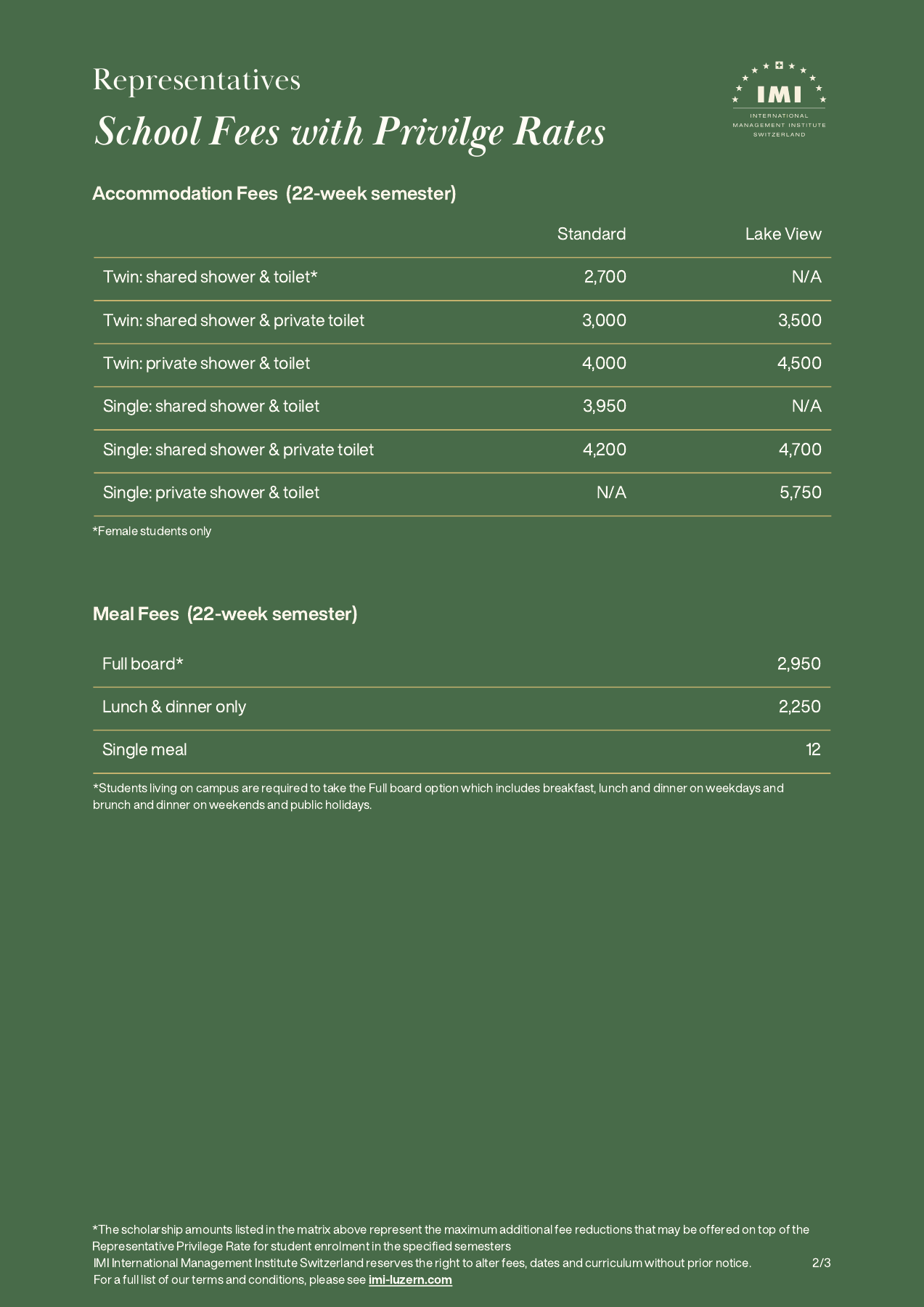
A CHF 3,000 twin room plus CHF 2,950 full board gives CHF 5,950 per study period, or CHF 17,850 across three periods. Added to the hospitality or business bachelor’s programme charges, the result is CHF 122,850 before approved benefits, flights, insurance, immigration expenses and living costs outside those periods.
What does LEP do about scholarships and partner benefits?
We have a formal partnership with IMI and maintain ongoing communication with the school. We help present the student’s strengths, relevant experience and reasons for the programme, and pursue applicable support.
Our work goes beyond forwarding a public price list. We clarify the original charge, the approved reduction, which study period it applies to, the resulting payment and whether later periods remain eligible.
Understanding the school’s net-investment illustration
The following comes from slides 44–45 of IMI Presentation 2026. It is a school illustration, not an individual offer.
| Item | One charging year of hospitality/business BA | MSc illustration |
|---|---|---|
| Tuition, registration and one campus living period | 40,950 | 44,950 |
| Illustrative partner benefit | −6,000 | −6,000 |
| Charges after that benefit | 34,950 | 38,950 |
| Gross placement wages used in the illustration | 14,340 over 6 months | 28,680 over 12 months |
| Subtraction shown | 20,610 | 10,270 |
CHF 20,610 is not the full three-year bachelor’s cost; CHF 10,270 is not an all-inclusive master’s price. Neither subtraction includes payroll deductions or internship living expenses. The separate MSc brochure lists up to 44 weeks of optional practice, so actual paid months must be based on the confirmed arrangement rather than assumed from this illustration.
Gross wages are not the amount available to offset tuition
For 2026, Swiss placements meeting the conditions of Article 11 of the hospitality collective agreement, L-GAV, have a minimum gross monthly wage of CHF 2,390. That is not a wage rule for placements in other countries.
These examples assume ten paid months. The expense assumptions include payroll deductions, insurance, accommodation, food and commuting; they are illustrations, not surveyed living-cost estimates.
| Assumed monthly related expenses | Ten-month gross wages | Ten-month related expenses | Remaining balance |
|---|---|---|---|
| CHF 1,500 | 23,900 | 15,000 | 8,900 |
| CHF 1,800 | 23,900 | 18,000 | 5,900 |
| CHF 2,100 | 23,900 | 21,000 | 2,900 |
Using the middle row, the bachelor’s calculation becomes CHF 122,850 − approved reductions − CHF 5,900 + other costs not yet included. Internship expenses have already been deducted in the CHF 5,900 balance and should not be counted twice.
Tuition generally becomes due before the student earns placement wages. We therefore also show the money needed at each payment date.
A winter programme can lead to a tuition credit
The 2027 winter programme has a CHF 1,800 early fee if full payment reaches IMI before 18 November 2026. After successful completion, joining an eligible longer-term course within two years can allow the fee actually paid to be credited against first-year tuition.
Paying CHF 1,800 means a potential CHF 1,800 credit under those conditions, not automatically CHF 3,000. Flights and personal insurance are outside the credit. We check whether it can be combined with another scholarship when progressing the longer-term application.
A budget should leave room for the next step
Starting work, continuing to a master’s or joining a family business require different financial preparation. We use the Yushufang Family Decision Framework to discuss the family’s resources alongside the student’s plans.
As a local European business operator, I also look at the experience, employer relationships and markets that could make the investment useful. Send us the programme, intended intake, budget and accommodation preferences. LEP can build a budget that includes benefit applications, living costs, realistic placement cash flow and payment dates.
Explore IMI programmes, costs and applications
- Why study hospitality management in Switzerland? Start with what you want to do afterwards
- Why choose IMI Switzerland? Curriculum, internships and value matter more to me than luxury facilities
- IMI bachelor’s, MSc or Graduate Diploma: which programme fits your next step?
- IMI internships and graduate careers: experience matters, and so does the person willing to recommend you
- Applying to IMI Switzerland? LEP can handle programme selection, scholarships and the application with you
- What I look for when visiting IMI: the student’s future beyond the campus
- IMI Winter Programme 2027: CHF 1,800 early fee and a possible credit towards later tuition
If you are facing this decision, let's talk. contact@luxedupartners.lu →