
| By James Liu | Lux Education Partners | 26 September 2026 |
I have visited IMI, SHMS and HIM. My assessment is clear: consider IMI for value; SHMS for hospitality, events and design; César Ritz for specialised business study; HIM for three internships; and CAA for ambitious culinary training.

LEP has formal partnerships with all five. We can recommend a course against the student’s goals and family budget, with a choice of schools rather than a single answer for everyone.
What does the extra investment give the student?
IMI International Management Institute Switzerland does not have the most luxurious facilities in this group. I nevertheless see strong value in its academic content, practical structure and potential partnership benefits. A higher investment in SHMS should serve a clear learning goal; César Ritz offers a four-year business structure and Swiss institutional accreditation; HIM provides three internships; CAA requires a genuine commitment to intensive culinary or pastry training.
Can the student use what costs more? Could the money saved support the next stage of their development? I consider both questions with the family.
Hospitality: IMI and SHMS
| Area | IMI | SHMS |
|---|---|---|
| Undergraduate focus | International hospitality business management | Hospitality, event or design management |
| Internships | Two compulsory 22-week placements and an optional third | Two international paid internships, according to the route |
| Course emphasis | Hotel business, accounting, revenue, people and international business | Hospitality operations with more explicit event or spatial-design pathways |
| My selection approach | Consider for a balance of budget and hospitality business training | Compare closely for a specific interest in events, design or its learning environment |
Business: IMI, César Ritz and HIM
IMI’s international business bachelor’s covers trade and finance, business law, strategy and cross-cultural management, alongside service-industry and practical foundations. César Ritz has six business specialisations and a separate applied AI bachelor’s, within a four-year undergraduate structure that includes an immersive year. HIM offers finance, marketing, management and hospitality, with three four-to-six-month internships in three years.
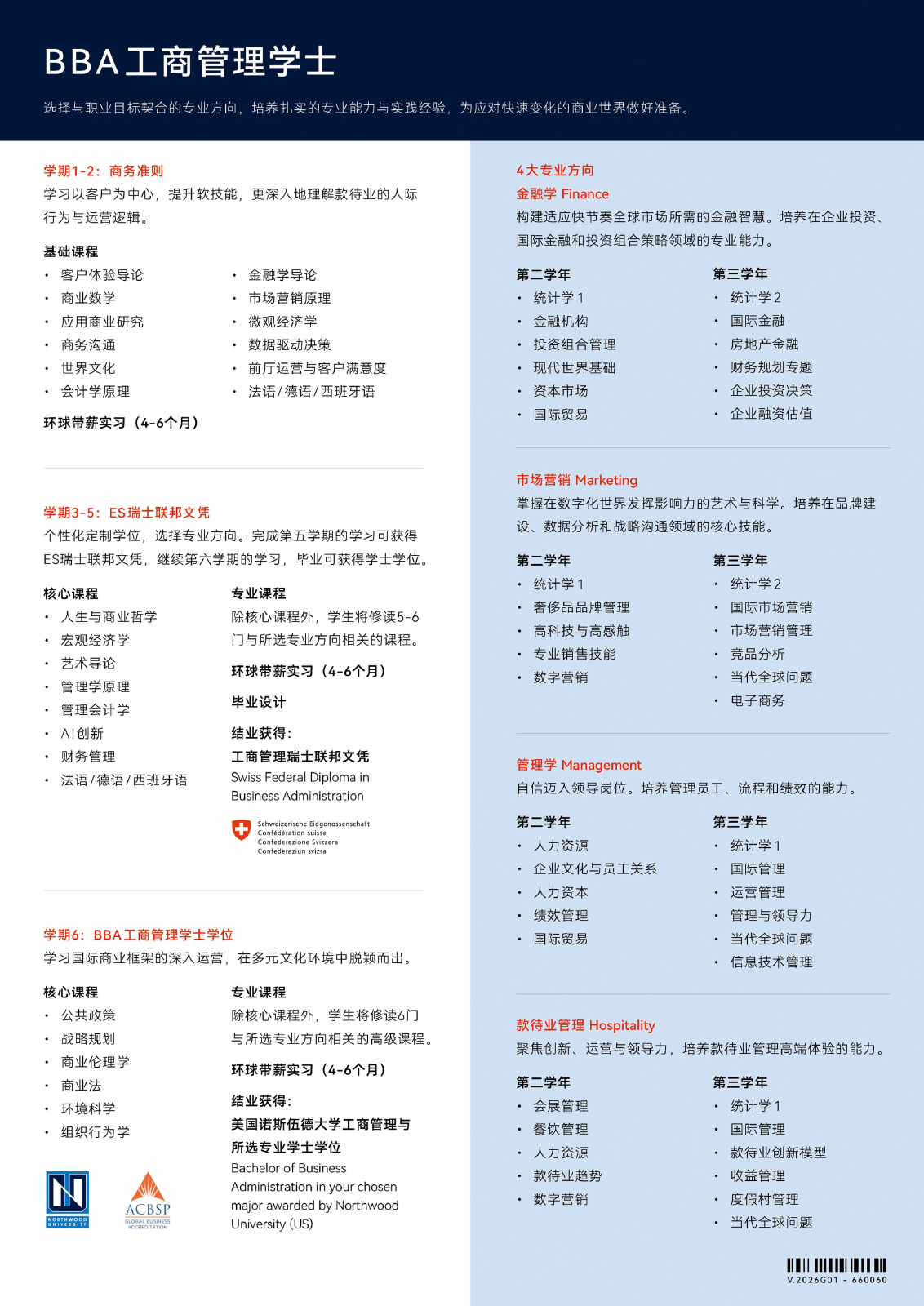
César Ritz’s applied AI option is a bachelor’s; HIM’s AI customer experience course discussed here is a master’s. They serve different educational stages.
Culinary arts: IMI and CAA
IMI’s international culinary management bachelor’s combines culinary work, baking, food safety, menus, commercial kitchen management and business. CAA separates culinary arts from pastry, baking and chocolate, with 1,100 kitchen hours and two internships. For students aiming at top kitchens, I see the latter as a demanding path towards mastery.
I ask about the student’s actual experience of cooking. If the ambition is to run a restaurant, we also discuss products, costs and operations; these help identify the training they need.
Budget comparison
These are budgets before scholarships, using current IMI fees and 2027 SEG fees. Figures may vary slightly; the school’s final confirmation for the application takes precedence.
| Route | Starting budget, CHF | Included basis |
|---|---|---|
| IMI hospitality or business bachelor’s | 122,850 | 105,000 tuition and registration plus three example shared-room/full-board periods at 5,950 each |
| HIM bachelor’s | 131,800 | Scheduled on-campus board included |
| César Ritz business bachelor’s | 169,300 | Full four-year route with scheduled on-campus board |
| CAA bachelor’s | 176,200 | Three-year route with scheduled board and relevant professional equipment |
| SHMS bachelor’s | 186,500 | Full bachelor’s route with scheduled on-campus board |
The IMI example is for hospitality or business, not the culinary bachelor’s. Expenses outside covered periods, insurance, deposits and personal spending must be accounted for as applicable. Confirmed scholarships bring the comparison closer to the family’s actual investment.
Further study and work: start with the destination
SHMS and CAA have University of Derby partnership degrees. HIM’s BBA is awarded by Northwood University, with the ES route’s status to be checked for the intake. César Ritz has Swiss institutional accreditation and its own relevant degrees. IMI lists Manchester Metropolitan University validation for its relevant current bachelor’s and MSc programmes.
For further study, the target university’s admission requirements matter. For employment, consider the role, language skills, internships and work authorisation. A student’s nationality and existing residence rights can materially affect the route; studying alone does not automatically resolve permission to work. I bring these questions into planning early, especially for families hoping the student will remain in Europe.
Why make this comparison with LEP?
I run businesses in Europe and visit schools regularly. We have substantial business relationships in Luxembourg, Switzerland and the Netherlands, and commercial contacts in Ireland and Austria. This lets us consider a school within a wider industry and employment context.
Schools want good students; businesses need suitable talent; we want people we can confidently recommend over time. Student selection and a good country-school match start that relationship. We open our networks to partner families and support graduate employment recommendations. In the near term, we communicate directly with schools about courses, applications and scholarships. Over the longer term, we help connect learning with business opportunities. Share the student’s situation and budget with LEP for a clear recommendation and application support.