
Start with the problem the student wants to solve
AI can mean very different educational ambitions. One student wants to build algorithms, another wants to develop software, and another wants to use technology to improve a hotel, brand or service business. Those aims call for different training.
My work as a business owner in Europe and my school visits shape the questions I ask about a degree: what business problem will the student understand, and where will they practise applying their knowledge? For LEP, the CRCS comparison centres on how business contexts, technical depth and internship tasks connect.
Three routes to compare
| Route | Main educational focus | Interest to explore |
|---|---|---|
| Computer science or software engineering | Computing, programming, systems and algorithms, with depth varying by university | Building technology or software; enjoyment of mathematics and coding |
| CRCS Hospitality Business Management | Service operations, finance, marketing and strategy | Running a business, management or entrepreneurship |
| CRCS Applied AI | AI applied to customers, revenue and processes, supported by service and business study | Business problems combined with a willingness to learn data and tools |
Consider a hotel trying to encourage repeat visits. A business student might examine customers, products and service; the applied AI route invites further questions about using customer data to identify needs, improve communication and measure results. This comparison helps families see the different capabilities each route develops.
LEP asks students to describe a business problem that actually interests them. We then compare the curriculum against that interest, giving the family a more concrete basis for judging motivation.
Where AI sits in the 2027 curriculum
The published full pathway is four years, 180 ECTS and two internships, with the first intake in October 2027. Service operations, communication and industry foundations lead into business, digital tools and applied AI.
Published topics include automation, customer intelligence, revenue management, sustainability and prototyping. A final Business Creation Project uses AI within a real business concept, bringing the learning into an entrepreneurial or business proposal.
Before an application, LEP takes practical questions to the school: which programming and data tools will students use? How demanding is the mathematics? What is completed individually or in teams? How can internships connect with analytics, operations or a commercial role? Those answers help assess both readiness and the work a student could eventually show an employer.
What would make the degree useful for employment?
Three capabilities are worth examining: understanding a business objective, handling and interpreting data, and communicating a proposal to colleagues or customers. Projects, internship responsibilities and feedback should provide evidence of those capabilities.
For a student interested in revenue management, digital operations, customer analytics or technology adoption in services, LEP translates the goal into questions about classes and placements. With the first intake scheduled for 2027, LEP examines the programme design, project requirements and career support against the student’s intended role.
English, cross-cultural communication and the local language of a target employment market also belong in the preparation plan. We discuss these alongside the course, so the academic choice supports a coherent career direction.
Preparing an application
The school lists completed secondary qualifications including high-school diplomas, IB, A Levels and equivalents. The published IELTS Academic threshold is 5.5 overall, with no component below 4.5. Readiness should also be assessed against English-medium teaching, data work and group projects.
Send LEP recent grades, mathematics background, English level, previous projects and the intended start date. We first compare business management with applied AI, then discuss entry requirements, preparation, internship structure and scholarships with the school.
Fees need a quotation for the selected programme. The 2027 Hospitality Business Management schedule helps explain how school charges are organised, but the applied AI price and payment schedule must be confirmed for that degree. Start with LEP’s CRCS visit, programmes and fees guide; we can then build the budget into the application plan.
Turn the comparison into an application with LEP
Send the student’s age, qualifications, grades, English level, intended start and full budget. Lux Education Partners (LEP), founded by James Liu and based in Luxembourg, supports school selection, direct school communication, applications, scholarship discussions and accompanied school visits in Europe. We bring course fit, preparation and costs into one application plan.
Email: contact@luxedupartners.lu. WeChat: xiuyinxiansheng. Explore LEP’s services and school visits.
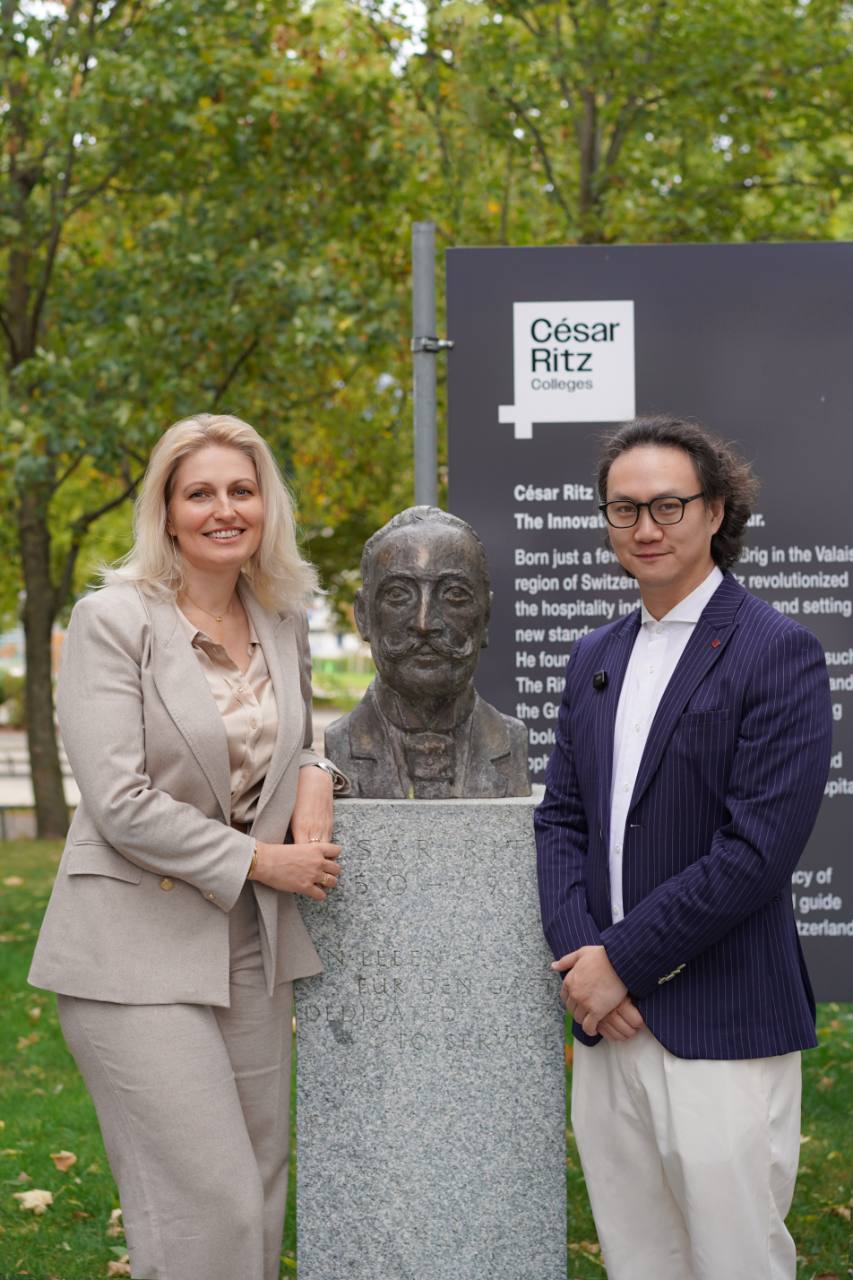
Sources: official CRCS degree, career-service and accreditation pages, the school’s 2027 fee schedule and course material; reviewed 24 October 2026. Visit photographs: James Liu’s October 2026 Swiss trip. Graduate work rules: SEM Working FAQ.